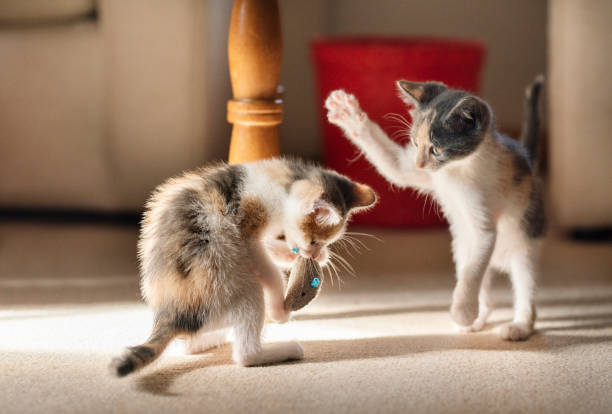
Do these kittens look like they’re having fun to you? I think so. If you agree, then the question that follows is: why?
There’s an idea called Natural Funativity or the Evolutionary Theory of Fun (ETF), which game design researchers have been playing with for over a century. It says, roughly, that “fun” is something we experience while practicing, in a safe place, skills that were once needed for survival.
These kittens are play fighting, play hunting. They love it, and they’ll do it for hours. Fighting and hunting were skills cats needed for millennia. Your cat may not actually need those skills now. But if it does, it’ll be better at them because of all this fun. That’s the idea, anyway.
Let’s take ETF and apply it to you and me. For most of human history we’ve been tribal hunter-gatherers. Each of those words can be tied to one (of the many) survival skills we’ve needed as a species.
Tribal: living in groups helped us survive, so we evolved to crave social connection. Hunter: we tracked things that moved, and now we’re built for spatial reasoning. Gatherer: we recognized the non-poisonous berries and remembered the location, and now we’re preprogrammed to recognize patterns.
That’s the theory. Let’s take it for a test drive. I’ve made a version of Snake, one of the first games ever put on a phone. In the game you control the direction of a continuously moving snake. The snake can eat berries, and when it does it grows longer. BUT if the snake runs into itself, or the wall, game over.
This was a fun game to make. The snake itself is very simple to model: it’s just a queue, a list of all the squares that need to be colored. After the player tells the game which way to go, we push that new square onto the front of the queue. The head adds a cell, the tail drops one, and that’s the whole trick. When the snake eats, you just skip dropping the tail, and the queue grows.
Snake also has spatial reasoning (don’t collide with yourself), pattern recognition (certain moves leave space to maneuver, others don’t), and even social interaction (I dare you to beat the high score).
Here it is, instructions and all. Go ahead, play it. Have fun!
Did you have fun?
Be honest, because it matters for what comes next. You probably did, at least a little. Your hunter’s brain tracked the food. Your gatherer’s brain read the pattern of your own tail. Something old in you woke up and enjoyed itself. That’s real. That was never fake.
The problem is that those evolutionary compulsions, spatial reasoning, pattern recognition, and social interaction, are there whether or not you’re actually having fun.
Casinos tune their machines to your pattern-recognition, each near-miss whispering “one more pull.” Shooters feed your spatial-reasoning the way a hunt once did, except endlessly. Similarly, social platforms have been sued for engineering our social drive into something with no bottom, because a scroll that can’t be finished is a scroll you can’t put down.
For some of these companies it was never about fun. They know what you know now: that there are evolutionary levers, and that you can pull them not to make something fun, but to make it a compulsion. Fun teaches you something and then lets you go. A compulsion just keeps you pulling.
So think about the last time an hour disappeared into a screen and you stood up feeling worse than when you sat down. That wasn’t fun. Fun doesn’t do that. That was the oldest, best part of you, the part that learned to hunt and gather and belong, running in a cage for someone else’s profit. They took the thing that was supposed to make your life bigger and used it to make it smaller. They want you alone, in the dark, thumbing a screen, feeling nothing.
I know how that sounds. I know it’s bleak.
But our instinct for fun isn’t the problem. It’s one of the best things evolution ever gave us, and it can be taken back. There’s a way to point that instinct at your own life instead of at someone’s bottom line, and I’m going to show it to you. Sit with the dark for now. The way out starts next time.